
The Agricultural Revolution in Al-Andalus

Updated: Apr 24

The Wise Men of the Earth – Treatise Writers and Scientists
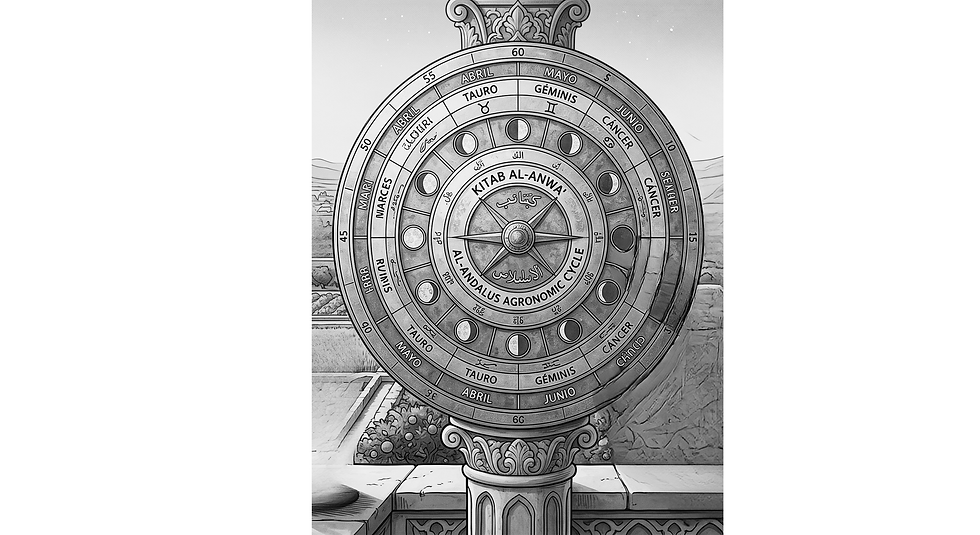
In Al-Andalus, agriculture was elevated to the category of science ('ilm al-falaha). While in the rest of Europe agricultural knowledge was fragmentary and traditional, in cities such as Córdoba, Seville, and Granada, the most advanced manuals of the Middle Ages were written.
1. The "Boom" of Agronomic Literature
From the 10th century onwards, a host of authors emerged who compiled classical knowledge (Greek and Roman) and enriched it with their own observations on the peninsula.
Ibn al-Awwam (Seville): Author of the Kitab al-Falaha (Book of Agriculture). It is probably the most complete agricultural treatise of medieval history, describing over 500 species and detailed grafting techniques.
Ibn Bassal (Toledo): A visionary who not only wrote but also directed the royal botanical gardens. His work focuses on practical application and soil classification.
Avenzoar (Seville): Although a physician, his studies on the relationship between food quality and health were fundamental to the development of specific crops.
2. Technical Innovation: Grafting and Taxonomy
Andalusian scientists not only catalogued plants but also perfected methods we still use today:
The Art of Grafting: They developed complex techniques to improve the resistance of fruit trees and the quality of the fruit (especially in citrus and olive trees).
Study of Soils: They classified lands according to their temperature, humidity, and composition, assigning each "soil type" a specific crop to maximize yield.
3. From the Laboratory to the Orchard
The most relevant aspect of these treatise writers is that their knowledge did not remain in the caliphs' libraries. There was a real transfer of knowledge to farmers through:
Experimentation in Almunias: The royal estates served as testing grounds.
Dissemination: Techniques were standardized and systematically applied in irrigation channels and community orchards.
This scientific approach allowed agriculture to cease being a subsistence activity and become a precision industry, optimizing every drop of water and every span of land.

Comments